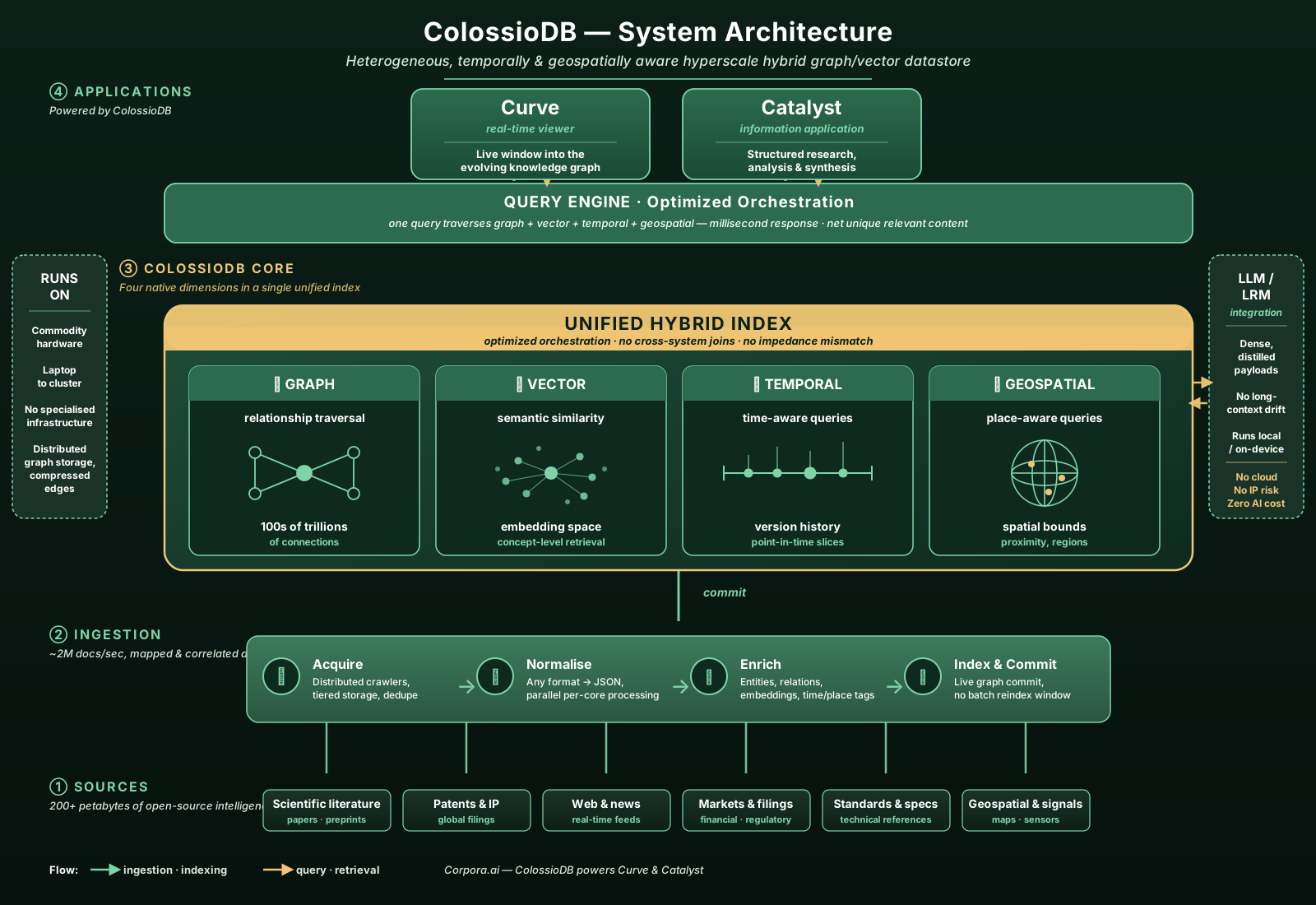
Radically Lower Complexity. Exponentially Better Scale. Improved Economics.
"Agentic" AI architectures are frequently used to compensate for what LLMs cannot inherently do at scale. They bolt on vector search for similarity, graph traversal for relationships, temporal engines for chronology, and geospatial systems for location awareness, forcing queries through layers of orchestration, retrieval, ranking, serialization, and context assembly.
That complexity comes at a cost: more infrastructure, more latency, more compute, more tokens, and exponentially more operational overhead.
- Conventional graph databases stall in the double-digit terabytes.
- Vector stores find semantic similarity but lose relational depth.
- Temporal and geospatial intelligence are typically isolated into separate platforms entirely.
The result is fragmented architectures where every answer requires cross-system joins, duplicated indexing, and expensive retrieval pipelines just to reconstruct context the platform never understood natively. Meanwhile input token counts explode, attention span gets stretched, and inference latency and cost rocket.
ColossioDB changes the economics of intelligence infrastructure.
Vast scale, graph, vector, temporal, and geospatial dimensions are unified inside a single native index and execution engine. Relationships, meaning, chronology, and location are resolved together in one query plan, in memory, without serialization overhead or distributed retrieval chains.
Instead of building increasingly complex agentic systems to compensate for fragmented data layers, ColossioDB makes context intrinsic to the database itself.
The implication is profound:
- Less retrieval orchestration
- Fewer inference passes
- Lower token consumption
- Reduced GPU dependency
- Faster reasoning over vastly larger knowledge spaces
- Dramatically lower operational cost at scale