
Supporting Blood Cancer Research and Showcasing Corpora's Scientific Frontier Research Platform to the Public Sector
This month: a new partnership to accelerate blood cancer research, the headline findings from our US 2025 research report, the launch of our Frontier Accelerator, a feature on destroying PFAS, and highlights from across the UK's AI ecosystem.
Corpora supports MSTART in funding the University of Warwick and ACT partnership to transform blood cancer research
We are proud to support a new initiative accelerating blood cancer research. In partnership with MSTART — founded by our CEO and Co-founder Mel Morris CBE — the University of Warwick / Warwick Medical School, and Accelerating Clinical Trials Ltd, founded by Professor Charlie Craddock CBE, we are helping to drive research breakthroughs in Acute Myeloid Leukaemia (AML).
Using our Scientific Frontier Research Platform, we will help to strengthen the national AML patient registry, enabling faster, data-driven insights for researchers and clinicians. Our technology will support the programmes' analysis of clinical literature, biomarkers, and treatment pathways to enable earlier diagnosis, improve clinical trial design, and identify predictive biomarkers.
Read the full press article on UKTechNews.
The State of In-Depth AI Research — US 2025 Research
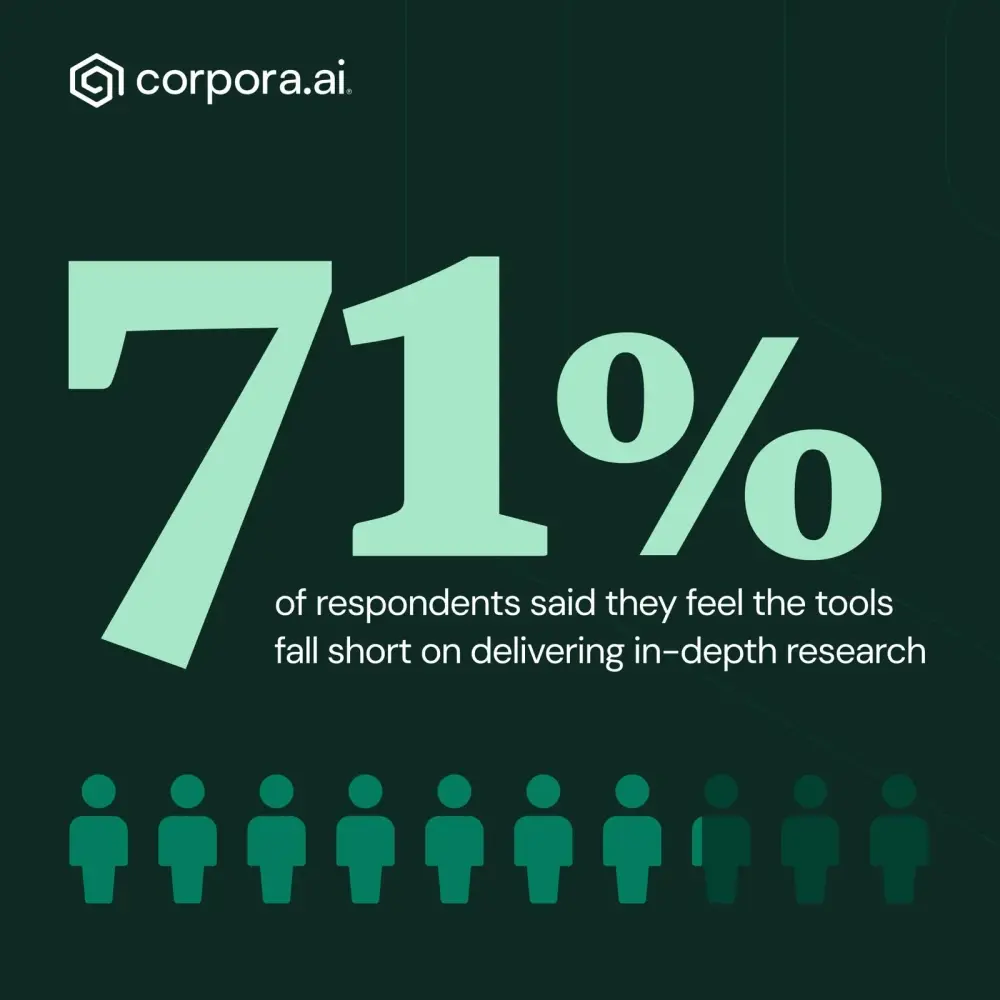
In 2025, we released our US research report based on insights from over 1,000 professionals across academia, R&D, journalism, and government.
The study shows that AI is now embedded in serious research workflows, with 57% using it for in-depth work and most engaging with it daily or weekly. However, while adoption is accelerating, trust continues to lag. Over 70% of respondents reported that current tools fall short on depth, transparency, and reliability, and many still treat AI outputs as a first draft rather than a final authority.
Researchers highlighted ongoing frustrations around verification, sourcing, and accuracy, with 61% feeling forced to trade speed for confidence. The findings point to a growing demand for stronger citation, auditability, and fact-checking capabilities.
Looking ahead, the research reveals a clear shift in expectations: users want highly customisable, well-organised, collaborative, and secure systems designed for real-world research. As data privacy and compliance become increasingly important, the next generation of AI tools will be defined not by faster answers but by trustworthy, verifiable insights.
Do you want to excel in your research? Look no further

We recently launched our Frontier Accelerator Program, a new initiative designed to support startups and innovators working at the cutting edge of biotech, life sciences, sustainability, materials science, defence, and aerospace.
The programme combines access to world-class frontier research technology with hands-on mentorship and support from our network of leading researchers, technologists, and industry experts. It is designed to help teams accelerate R&D while maintaining rigorous, evidence-based research standards — helping frontier innovators turn breakthrough ideas into real-world impact, faster and with greater confidence.
If you're interested, or know anyone who could be, please email [email protected].
New ambassador announcement

We welcome a new ambassador: Dr Aqib Bhatti. With a first-class record in the medical health industry, and now serving as Chief Medical Officer at DHU Healthcare, we're pleased to share this news with our community. His remarkable career, expertise, and insights will bring significant value to Corpora, its partners, and the frontiers of the medical sector.
Ambassador Takeover: Alexander Reip on PFAS

One of our ambassadors, Professor Alexander Reip, has used Corpora's platform to explore PFAS and potential ways it can be destroyed in water systems using UCR Group's technology. Read his feature below.
PFAS (per- and polyfluoroalkyl substances) have moved rapidly from being a niche technical issue to a mainstream environmental and policy priority. Over the past year, the Royal Society of Chemistry has been heavily engaged in policy discussions on PFAS, working to ensure decisions are grounded in robust science and proportionate risk assessment. That sustained engagement has helped shape the current direction of travel, with the UK Government now putting clearer regulatory expectations and monitoring frameworks in place. This is an important step forward, but regulation alone does not solve the underlying technical challenge.
PFAS are often described as "forever chemicals", and for good reason. The carbon–fluorine bond that gives them their remarkable stability is what makes them so valuable in applications ranging from non-stick cookware and waterproof textiles through to medical devices and advanced energy systems. It is also what makes them exceptionally persistent in the environment. While guidance is improving and priority substances are being identified, we still lack scalable, evidence-based routes for the safe destruction of many PFAS — not just their containment or substitution.
"This is where I have found Corpora genuinely valuable. One of the hardest parts of working on PFAS is the sheer fragmentation of the literature — relevant insights are scattered across environmental chemistry, electrochemistry, catalysis, plasma processing, and water treatment. Corpora allows me to rapidly pull together and interrogate this body of work, with clear citations and traceable sources, which is essential when operating close to policy and industry decision-making."
"AI will not solve the PFAS problem on its own. But used well, it can accelerate how we identify credible destruction pathways, challenge assumptions, and focus experimental effort where it has the best chance of real-world impact." — Professor Alexander Reip
Corpora showcasing at the London AI Hub, Techspace
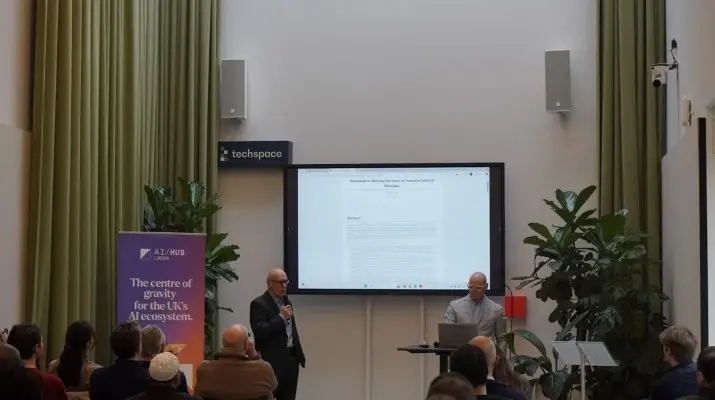
A few weeks ago, our CEO and Co-founder Mel Morris CBE, alongside our CMO David Pugh-Jones (DPJ), represented Corpora at the London AI Hub and Founders Forum Group. They demonstrated our Scientific Frontier Research Platform, and attendees were given an exclusive preview of how it generates comprehensive, evidence-backed reports in real time.
How do we build a better Britain with AI?
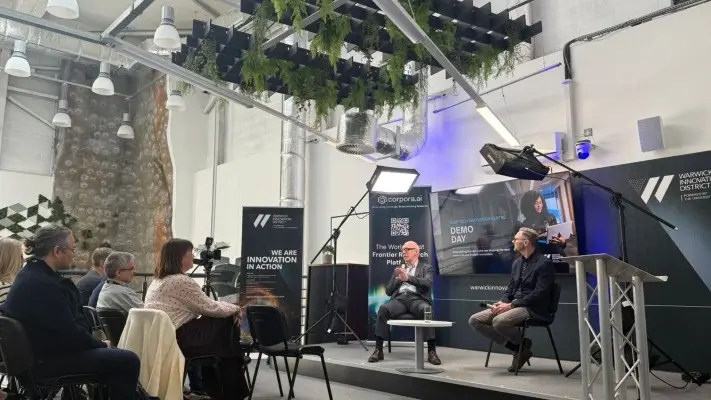
Corpora also attended an event hosted by the Incubator for Artificial Intelligence, featuring insightful discussions on how the UK can lead in the AI era. Panel speakers highlighted defence, talent, and institutional momentum as critical drivers of progress. Jade L. emphasised the role of defence and decisive government leadership, while Kalbir Sohi highlighted the importance of attracting and empowering top AI talent. A central theme was building public trust in AI — speakers agreed that trust comes from real-world impact, transparency, and accountability, not "black box" systems.
AI Minister event
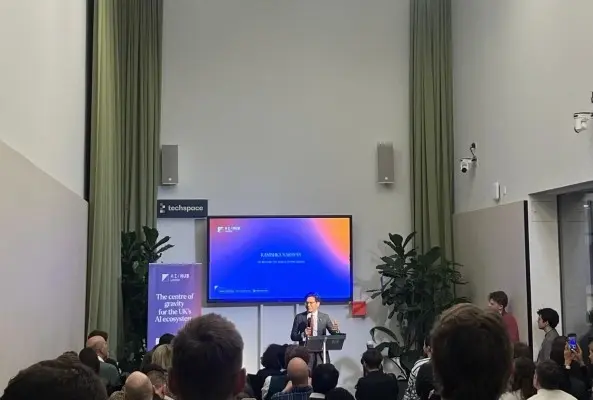
The Corpora team recently attended the London AI Hub × Founders Forum Group event on how the UK can drive AI transformation. The event — featuring Carolyn Dawson and a fireside chat led by Husayn Kassai — highlighted the strong momentum in Britain's AI ecosystem. UK AI Minister Kanishka Narayan MP emphasised that while the UK has world-class talent and research, it must move faster and act more boldly to lead in frontier AI. Discussions focused on strengthening access to capital, compute, and data, supporting startups to scale, and ensuring the UK becomes a home for globally successful companies. A strong emphasis was also placed on inclusion and supporting women in tech.
Make sure to follow Corpora.ai and our monthly newsletter for more insights!