Innovation on Earth and Beyond

This month's newsletter is a mix of what's been happening in the world of Corpora, alongside a feature piece on space exploration from the CCO at UCR Group. But first, three highlights from April: we released our UK Research Report, our CEO & Co-founder Mel Morris CBE visited the University of Warwick, and UCR's CEO shared some powerful insights.
The Foundation of Future Research: Speed, Trust, and Verification
Following our study from late 2025, we've now released our UK Research Report — our first ever report — on how speed, verification, and trust are the core pillars of a solid foundation for future research.
You can read and download the full report here.
Warwick Innovation District Showcase
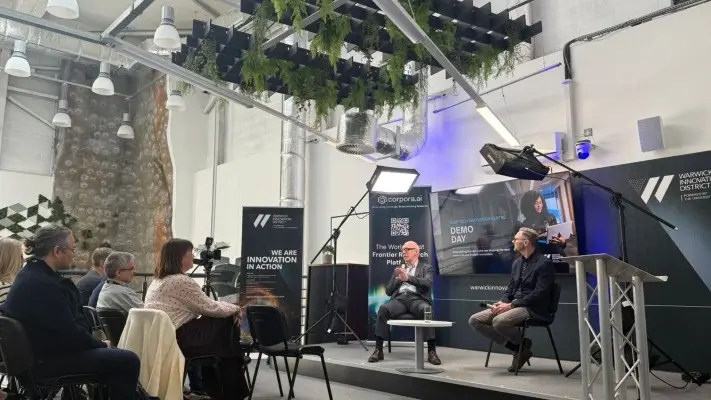
At the Warwick Innovation District Deep Tech Innovation Showcase Day last week, Corpora's CEO & Co-Founder Mel Morris CBE shared a key message for founders in deep tech: don't focus on feasibility — focus on viability.
The real challenge isn't whether people understand your innovation, but whether it can succeed commercially. What's the go-to-market path? How will it drive adoption and revenue? He also noted that "VCs follow fashion," meaning investors may not immediately grasp novel markets or technologies. Partnering with people who truly understand your space can accelerate success — because innovation alone isn't enough; viability is what wins.
Read a breakdown from the session here.
"We're in the loop that changes the equation"
For Earth Day on April 22nd, we had a conversation with Keith C. at UCR Group, focusing on AI and a sustainable future in the energy and materials science sector. What he said was truly inspiring:
Every Earth Day brings familiar conversations about reducing harm — lighter footprints, fewer emissions, better offsets. Meanwhile, we're living through the largest infrastructure build-out in human history, using 20th-century materials and energy systems. Every solar farm, battery pack, and data centre runs on AI compute, yet is still built with limited-performance materials and grids designed for centralised generation. This mismatch isn't a detail — it's the central engineering problem of the next 50 years.
But the outlook is changing. The same AI systems exposing these limitations are becoming the most powerful research tools we've built. At UCR Group, we've employed frontier AI research to accelerate the developments needed to make AI's own expansion sustainable — unprecedented material resilience, modified circuit conditioning that turns renewable intermittency into a designed input, and composite architectures for electrification that no 20th-century lab could have achieved. We're now in the loop that changes the equation. AI is no longer a burden on the grid — it becomes the tool that designs a grid able to deliver and expand with the power required.
Sunlight is abundant. Wind is abundant. Intelligence is increasingly abundant. A sustainable future uses all three to build the systems needed for equilibrium. That's the future we're building.
About UCR. Universal Collaboration Research (UCR) is a UK-based, award-winning developer of breakthrough energy technologies and advanced materials. UCR's transformative Inductive Capacitor Device (ICD) reduces energy consumption by over 60% in electrolytic processes. UCR's sustainable technology also enables the generation of ceramic alloy composite materials with ultra-resilience to degradation — fused to components to extend operational life and increase efficiency by 20% or more, reducing the carbon impact of entire supply chains. UCR's technology enables decarbonisation across industries with minimal impact while improving profitability.
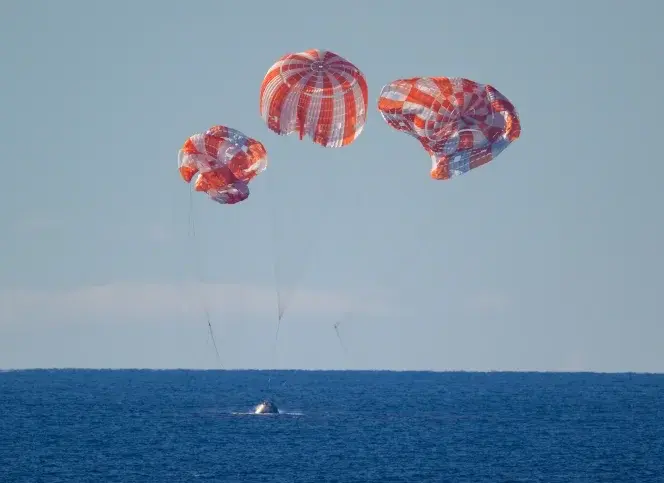
Artemis II Splashdown — Materials, Energy and Frontier Research in the Next Phase of Space Exploration
This month's feature article is all about aerospace. We've had the privilege to share a piece from Daniel Hayes MRAeS, CCO at UCR Group, on deep space innovation. Enjoy reading!
The successful splashdown of Artemis II on Friday, 10th April, marks a decisive moment in the return to human space exploration.
For the first time in over fifty years, a crewed mission has travelled to the vicinity of the Moon and returned safely to Earth aboard the Orion spacecraft. This is more than a symbolic achievement. It is a validation of the systems required to operate beyond low Earth orbit and a signal that the focus now shifts to endurance.
The question is no longer whether we can reach the Moon. That capability was demonstrated decades ago. The challenge now is whether we can operate there in a sustained, reliable and efficient manner.
Lunar and cislunar environments present a convergence of constraints that challenge conventional engineering approaches. Extreme thermal cycling, persistent radiation exposure and the abrasive nature of lunar regolith combine to create conditions that are both hostile and continuous. These are not isolated technical problems. They are interdependent system challenges in which materials, energy and environmental response must function as a coherent whole.
Historically, aerospace innovation has relied on incremental improvement. Stronger alloys, improved coatings and refined shielding have delivered meaningful gains. However, as operating conditions intensify, these approaches are reaching their limits. In extreme environments, materials themselves are now the constraint, as high heat flux, plasma interaction, electromagnetic effects and repeated thermal cycling converge beyond the design envelope of conventional systems.
Addressing this constraint requires a different approach. It demands a shift in how materials are formed, controlled and integrated into the system. At UCR Group, this shift is being realised through the development of advanced ceramic materials using a proprietary ultra-micro arc plasma synthesis process. Enabled by an award-winning Inductive Capacitor Device, this approach reduces the energy barrier associated with advanced ceramic formation by modulating electrical input, retuning distortions and capturing system losses. The result is a more controlled plasma environment, capable of generating novel material architectures that extend beyond the limits of conventional coatings.
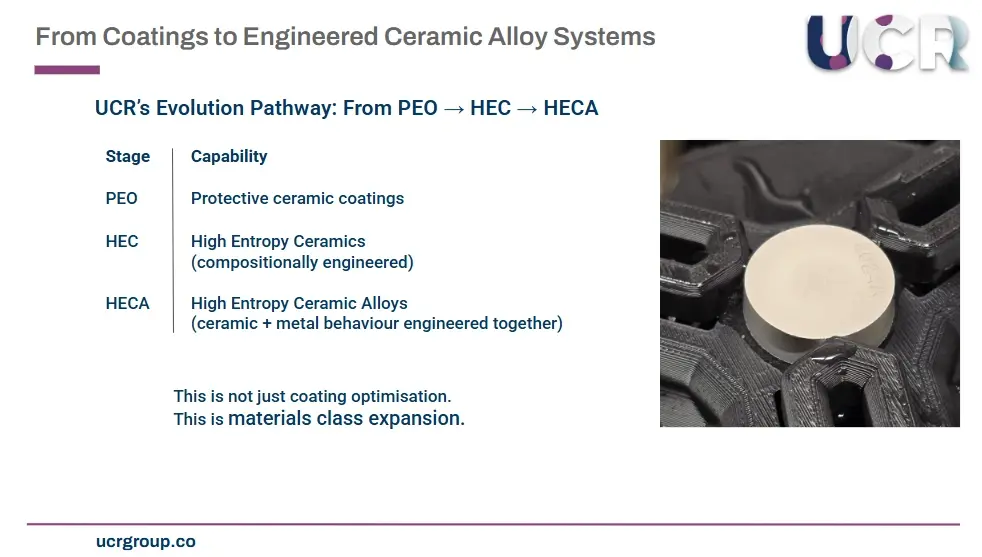
Advanced ceramic systems, including high-entropy ceramic alloys, offer a pathway supporting this shift. By engineering complex microstructures, these materials can maintain stability at extreme temperatures, resist long-term degradation and provide resilience in abrasive environments. More importantly, they introduce the potential for functional behaviour at the material level, where structures respond dynamically to changes in temperature and stress rather than simply resisting them.
Under the leadership of Keith C., CEO of UCR Group, the impact of this materials-class expansion is being validated via a range of collaborative material research programs. Professor Alexander Reip is now leading the materials research division of UCR and supervising the potential for high-impact hypersonic and space materials.
Radiation remains a further constraint. Unlike thermal or mechanical stress, it acts over time at the microstructural level, degrading material properties and impacting both system integrity and human safety. Conventional shielding approaches are mass-intensive and therefore limiting. The development of multi-functional materials that combine structural performance with radiation attenuation offers a more efficient pathway, particularly where these properties can be integrated directly into the material architecture.
Alongside materials, energy systems will define the viability of sustained operations. Lunar infrastructure must operate under intermittent generation conditions and extended periods of darkness. Under these constraints, efficiency becomes a primary driver of capability. Approaches that optimise energy capture and utilisation within the system, including modified resonant circuit architectures, offer the potential to extend operational performance without fundamentally increasing system complexity.
The challenge is not solely technical. It is also informational. Materials science, radiation physics, energy systems and aerospace engineering are deeply interconnected, yet research across these domains remains fragmented.
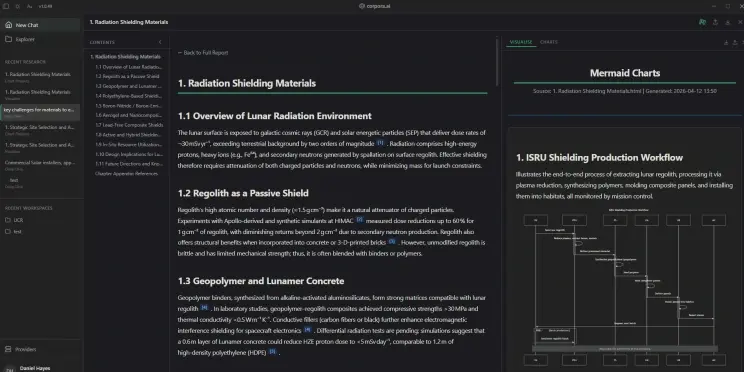
This is where Corpora.ai becomes significant. By structuring and interrogating high-quality technical data across disciplines, Corpora enables the identification of non-obvious connections and supports accelerated research pathways from concept to application. In this context, artificial intelligence is not an adjunct to engineering. It is an enabling capability for discovery itself.
The Artemis programme has re-established the pathway to deep space. The next phase will be defined not by the ability to reach the lunar surface, but by the ability to remain there and to build systems that endure. This will depend on the integration of advanced materials, efficient energy systems and intelligent research approaches.
About the author. Daniel Hayes has over 25 years of proven technology development experience within highly regulated industries. He is also the founder of an eVTOL aerospace entity (exited in September 2022), a board member of UCR Group and ABBS, and an advisor to various aerospace ventures.
Thank you for following along this month, and see you in the next newsletter! Please contact us at [email protected] for any questions.